Long-tail / rarity analysis
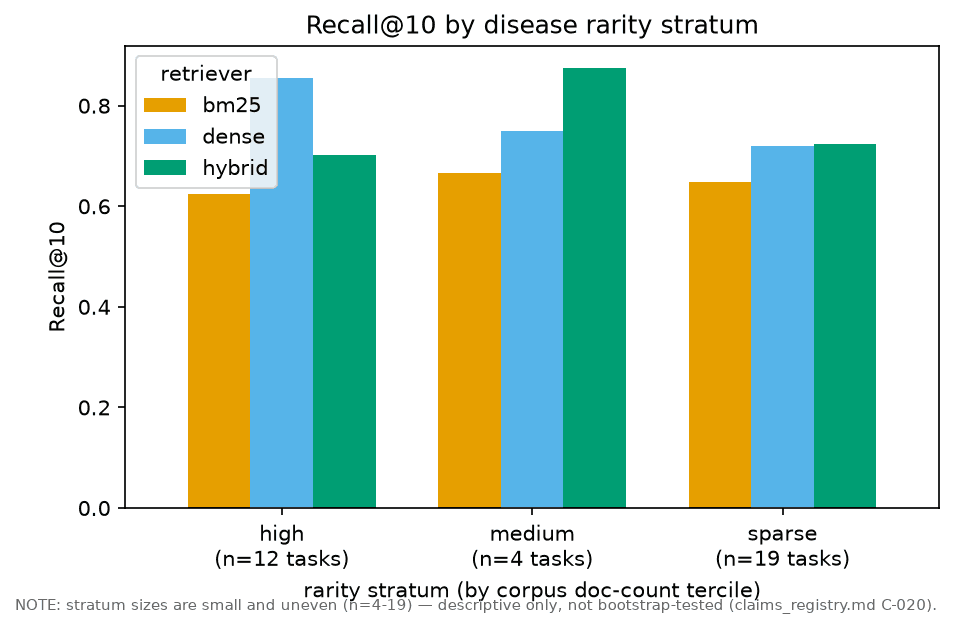
RQ7: does RAG quality degrade as disease evidence gets sparser? Recall@10 by rarity stratum and retriever, on the v1 task set.
Recall@10 by rarity stratum and retriever
| Rarity stratum | n tasks | BM25 | Dense | Hybrid |
|---|---|---|---|---|
| high | 12 | 0.625 | 0.854 | 0.701 |
| medium | 4 | 0.667 | 0.750 | 0.875 |
| sparse | 19 | 0.649 | 0.719 | 0.724 |
Dense retrieval’s Recall@10 declines with rarity — high=0.854 → medium=0.750 → sparse=0.719 — the same direction as the v0 preliminary finding, now on roughly double the sample (claims_registry.md C-020). This held up under more data rather than disappearing, which is modestly reassuring for RQ7, but is still not a bootstrap-confirmed effect.
Figure
Why rarity strata, not raw prevalence
The rarity stratum is a reproducible corpus-coverage proxy — document count in the frozen corpus, split into terciles — not an external prevalence claim. A disease with few indexed papers may still be well understood clinically through channels this corpus doesn’t capture. Findings here generalize only as far as this project’s disease selection does, which was chosen for a spread across the proxy and ontology-ID availability, not randomly sampled from all known rare diseases.