Methodology
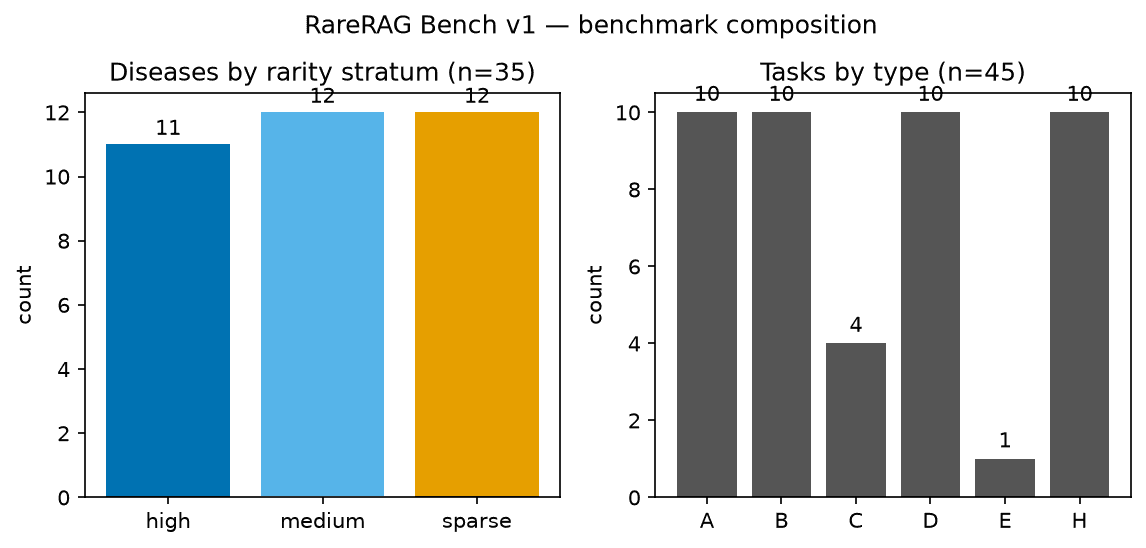
A reader-friendly summary of research/benchmark_spec.md — task types, metrics, corpus construction, and chunking. This benchmark's numbers scope: v1 is 35 diseases, 832 documents, 45 tasks.
Corpus construction
Disease identifiers (MONDO ID, cross-referenced to Orphanet where available) are resolved programmatically via an ontology lookup tool, never hand-typed. Each disease has a synonym table pulled from MONDO’s own synonym/xref fields — query normalization always resolves through this table before hitting the retriever.
Each document record carries: doc_id, source, external_id (PMID), title, passages (abstract at minimum), publication date, authors, disease/gene entity links, source type, license, and retrieval timestamp. The corpus is frozen at a single retrieval timestamp and content-hashed for release reproducibility — no document is silently added, removed, or edited after a version is tagged.
v1 uses PubMed abstracts only (metadata + abstract text via NCBI E-utilities), capped around 24 documents per disease, giving 832 documents across 35 diseases. PMC full text was deferred (an FTP retirement transition was in flight at data-collection time), and OMIM was excluded entirely (its terms bar redistribution).
Rarity strata
A reproducible proxy computed from the frozen corpus itself, not an external prevalence claim: doc_count is the number of corpus documents tagged with a disease’s MONDO ID after synonym expansion. Diseases are split into terciles — high (top third by doc_count), medium (middle third), sparse (bottom third, the long tail this benchmark is designed to probe).
Task types
v1 task-type distribution (45 tasks total):
| Code | Task | Gold shape |
|---|---|---|
| A | Disease → phenotype retrieval | Gold doc/passage set citing a phenotype-disease link |
| B | Disease → gene association retrieval | Gold docs supporting a gene-disease link |
| C | Gene → disease evidence | Inverse of B |
| D | Disease → mechanism literature | Gold docs describing pathophysiology |
| E | Differential retrieval between similar rare diseases | Gold docs distinguishing disease X from confusable disease Y |
| H | Insufficient-evidence questions | Gold answer is abstention; constructed from genuinely uncovered gaps in the frozen corpus, not invented gaps |
Type H construction rule: an insufficient-evidence question is only valid if a curator confirms, at corpus-freeze time, that the frozen corpus genuinely contains no supporting passage — verified by full-text grep, not a lazy search — documented in each task’s ambiguity_notes.
Retrieval pipeline stages
- 1. BM25 (lexical)
- 2. Dense (biomedical sentence embeddings)
- 3. Hybrid (reciprocal rank fusion of BM25 + dense)
- 4. + Cross-encoder reranking (optional stage)
Chunking variants
Chunking is treated as an independent variable in the spec, not fixed in advance:
- Abstract-level (one chunk = full abstract)
- Fixed-token windows (e.g. 256 tokens, with overlap)
- Sentence-group chunks
- Section-aware chunks (where full text with section markers is available)
Metrics
Recall@k, Precision@k, MRR, nDCG@k, Success@k. Recall@k is the headline metric for sparse strata by design.
Support rate, contradiction-acknowledgment rate, unsupported-claim rate, selective accuracy at a given abstention rate.
Paired bootstrap over questions for all comparative claims, reported as 95% CI — never a bare point estimate.
Claim-level answer schema
Every generated answer is decomposed into atomic claims, each with its own evidence and grading:
{
  answer_text,
  claims: [
    {
      claim_text,
      evidence: [doc_id...],
      confidence,       // model-reported, not benchmark ground truth
      support_status,   // supported | unsupported | contradicted | unverified
    }
  ]
}
Benchmark composition